book review · A Foray into the Worlds of Animals and Humans
A Foray into the Worlds of Animals and Humans by Jakob von Uexküll
2026-03-03 · 3 min read
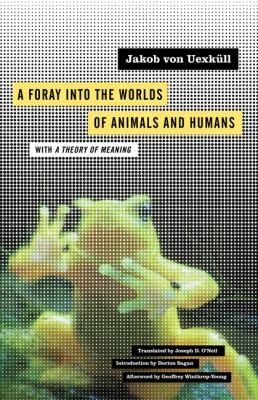
Not my usual lane, but a friend doing grad work in philosophy handed me this one insisting I’d get something out of it even without the background, and she wasn’t wrong. Von Uexküll was a biologist, not a philosopher, and this book reads like one, close, patient descriptions of how a tick perceives its environment, how a sea urchin’s world is built entirely out of touch and light with no sense of distance at all. He calls each animal’s private sensory bubble its Umwelt, and once you have that word you can’t stop noticing how much of what you assume is “the world” is actually just your own species’ narrow slice of it.
The honest word for this book is quirky, and I mean that as a compliment. It doesn’t argue like a philosophy text, it shows you tick after tick after tick until the idea just sort of arrives on its own. What surprised me is how directly this fed into people I actually had read, Heidegger leaned on it, Merleau-Ponty built whole arguments out of it in The Structure of Behaviour, and Hans Jonas picked it up again decades later in The Phenomenon of Life. You can trace a straight line from a guy staring at ticks in the 1930s to some of the heaviest phenomenology of the following fifty years, and nobody tells you that going in.
It’s short, maybe 200 pages including the theory-of-meaning essay tacked on at the end, but it’s dense in the way old biology writing gets dense, lots of careful qualification, not much hand-holding. I read it slower than I expected to. Worth it though. It’s the rare science book from ninety years ago that still changes how you look at your own dog.